


16 Jun 2026
Business leaders’ confidence in 2026: stable, stretched and still investing
Spend time with business leaders right now and a consistent picture emerges. There is no sense of panic, but there is no exuberance either. Instead, there is something more nuanced, a steady sense of moving forward, but under pressure.
Across a series of regional events in May 2026, bringing together over 350 CFOs and finance directors from across the South Coast and South West, we asked these business leaders about their outlook, their challenges and their plans. What came back was not contradiction, it was tension. A tension between external pressure and internal ambition.
A mindset defined by caution, not crisis
At first glance, business confidence appears evenly balanced for business leaders. Some organisations are more positive about the year ahead, others more pessimistic and many expect conditions to remain broadly the same.
The real story sits beneath that balance.
Very few business leaders describe the outlook as strongly positive. Instead, the language they use paints a more grounded picture. Words like challenging, uncertain, cautious, busy and finely balanced appear again and again. Even where optimism is present, it is often tempered. Hopeful, but restrained. Positive, but cautious.
This is not a loss of confidence. It is an understandable lack of clarity when it comes to the world beyond their business’s doors. Businesses are moving forward, but without full visibility of what lies ahead.
The twin pressures shaping the environment for business leaders
When asked about the risks they face, two factors dominate with striking consistency. The first is cost inflation and the second is demand uncertainty. This is reflected clearly in the data:
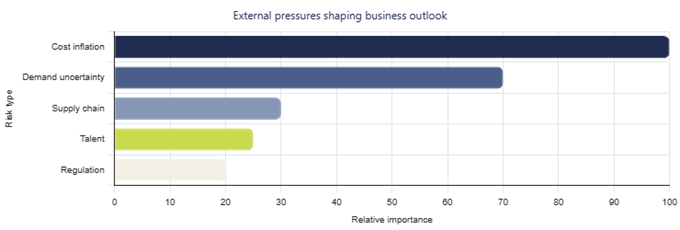
Cost inflation and demand uncertainty dominate, with all other risks secondary by comparison.
Organisations continue to face rising input costs, from labour to energy to materials. At the same time, revenue visibility has become more difficult. Pipelines are less predictable, customer behaviour is harder to anticipate, and planning horizons are shorter.
Together, these pressures create a challenging operating environment. Margins are squeezed while visibility is reduced. Decision making becomes more complex and confidence more fragile.
Internal constraints facing business leaders
What emerges even more strongly, however, is that the biggest barriers to progress are not only external. They are increasingly internal.
Across all event locations in Cornwall, Devon, Somerset, Dorset, Hampshire and Bristol, businesses describe being stretched. Time, capacity and prioritisation come up repeatedly. Teams are operating at full stretch, managing competing demands and making constant trade-offs about where to focus.
Alongside this sit ongoing people challenges. Recruitment remains difficult, retention is an issue, and skills gaps continue to affect delivery. At the same time, many organisations are grappling with the efficiency of their operations. Processes, systems and ways of working are under scrutiny.
Technology, and particularly AI, runs through many of these conversations. There is clear interest and intent, but also uncertainty about how best to adopt and implement it in practice.
The result is a bottleneck. Opportunities exist, but organisations are not always structured to take full advantage of them. The challenge is not just deciding what to do, it is having the capacity to do it.
Resilience is showing through investment
The picture shifts when we look at investment intentions:
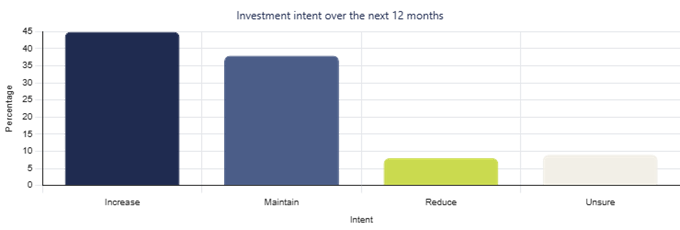
Despite pressure and uncertainty, the majority of organisations are maintaining or increasing investment.
Given this backdrop, a pullback in investment might be expected. That is not what we are seeing.
Most organisations plan to either maintain or increase their level of investment over the next 12 months. Only a small minority expect to reduce spend.
This points to a more resilient underlying picture. Businesses are not retreating in the face of uncertainty. They are choosing to respond to it and to demonstrate both confidence and, it seems, a willingness to adapt, in their long-term outlook.
A shift towards targeted, capability-led investment
Where that investment is being directed tells a more important story:
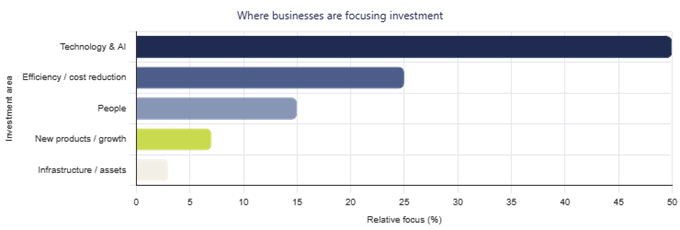
Investment is heavily concentrated in technology and efficiency, with growth-led areas a clear secondary priority.
Across the board, investment is overwhelmingly concentrated in technology, automation and AI, with a secondary focus on efficiency and cost reduction. Investment in people remains important, but is increasingly considered alongside technology rather than in isolation.
Growth activity is still present, whether through new products, services or markets, but it is not the dominant theme.
Instead, investment is being used to address constraints. To improve productivity, create capacity and make organisations more effective in an environment where both internal and external pressures persist.
This is not expansion-led investment in the traditional sense. It is capability-led investment. It reflects a shift in mindset, from pursuing growth at pace to building the foundations that make growth sustainable.
What this means for business leaders in the year ahead
Taken together, these insights point to a clear conclusion.
The business community in the South and South West is not standing still, but its members are navigating with care. Rising costs, uncertain demand and internal capacity constraints are shaping decisions at every level.
What stands out is how deliberate those decisions have become. Investment is more focused. Priorities are more tightly defined. There is a stronger emphasis on efficiency, capability and resilience than on rapid expansion.
In many ways, this reflects a shift in how organisations are approaching growth more generally. The focus is not simply on moving faster, but on becoming better equipped to deal with what comes next.
And in a period defined by uncertainty, that may prove to be a position of real strength.
Are you a business leader?
We’d love to hear from you.
Latest news




Budget 2026: Will family businesses get help to grow or just another tax squeeze?
5 October 2026
Read
Academy trusts: key findings from the Department for Education assurance report
25 September 2026
Read

Capital Goods Scheme threshold rise to £600,000 : When does the new limit apply?
24 September 2026
Read


Business exit strategy and succession: routes, tax considerations and how to choose
16 September 2026
Read